-- Section still in works --
1) NPO during labor (nothing by mouth also known as "nil per os")
- ACOG (American Congress of Obstetricians and Gynecologists) Committee Opinion
- NPO during labor. Is there any scientific validation?
- Eating and Drinking during Labor and Perinatal Outcomes - Midwives' point of view
- Evidence overview by Evidence Based Birth
2) Induction of labor - there might be many reasons for induction, some more and some less legitimate. I will elaborate on it more in depth.
In the meantime, here is a list of natural ways to bring on labor and prepare your body for it.
Those things below may get a woman's body more ready for labor and birth and be helpful anyway even if they do not start it on:
- Acupuncture: referrals attached
- Acupressure: instructions below
- Chiropractic adjustments (Webster techniques): referrals attached
- Sexual intercourse: semen contains cervix-softening fats called prostaglandins and a woman’s orgasm can lead to uterine contractions (not recommended if water was released)
- Nipple stimulation: either by a partner, yourself or with a pump; nipple stimulation triggers oxytocin production which can bring contractions; oxytocin is one of the main hormones of childbirth; it helps to start the labor and to progress it; it also helps the mother to feel some bliss in between intense contractions
- Other things that stimulates oxytocin: massage, soft music, chocolate or other treats you love, safety, having good time, laughing
- Walking: nice paced walk, at least 5km/3miles per day
- Address you emotional stage: ask yourself if there is anything that might be blocking you from going into labor
- Evening Primrose Oil: helps to ripen/soften the cervix by imitating prostaglandins; it can be used orally and/or internally; please research more on this method or ask your doctor if you'd like to try it
- Induction Massage: can be given on or after your estimated delivery date; the massage therapist (who should be experienced in induction massage) will work on acupressure points which are normally avoided during pregnancy, which can trigger labor. As with normal massage, induction massage helps to relax and calm your body, easing tension and helping to create a clear and grounded space. The therapist may also use essential oils which can assist with bringing on labor.
- Essential oils: 1 article here: https://www.thedabblist.com/7-essential-oils-to-facilitate-labor-naturally but please research more on your own if interested
- Homeopathics: some homeopathic remedies help encourage labor, however you will need to consult a qualified homeopath for more information on dosages
- Some foods: spicy food and curry gives some people the runs; some people swear by it for getting their labor started; I am not a big fun of getting your intestinal track involved into triggering the labor; date fruit apparently have some impact on labor (there was even a study done on it); the study concluded that the consumption of date fruit in the last 4 weeks before labor significantly reduced the need for induction and augmentation of labor, and produced a more favorable, but non-significant, delivery outcome
- mentioning here, although I would not recommend using those methods and am only mentioning in case you'd find them in other places: castor oil - can be very strong and produce not desirable effect; black and blue cohosh (herbs) - to be used only under supervision of a herbalist or midwife
Acupuncturists: (attached)
- Qi Li Acupuncture Center: http://qiliacupuncture.com on the UWS have great reputation among pregnant mamas
- Stephanie Propper does home (and hospital!) visits.
Acupressure: you can do it yourself or with help of your partner
Those 2 points help to encourage efficient contractions and cervical dilatation.
Hegu

This point is found between the first and second metacarpal bones (the bones of the thumb and first finger). It lies at the highest point formed when the thumb is brought to rest against the index finger.
The woman or her support person can firm pressure with their thumb. This acupressure point has a dull achy feeling when located correctly.
Press for a few minutes (1 to 5) a few times per day. Or more often until you feel things start moving.
Another point on the internal part of the leg
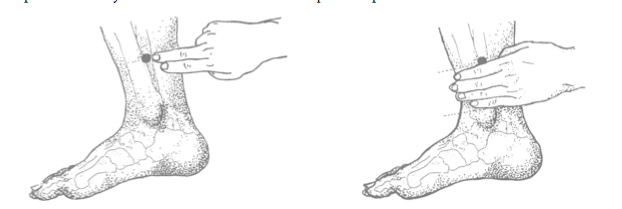
This acupressure point is located using four of the woman’s finger widths above the tip of the medial malleous (the shin bone on the inside of the ankle). This area will often be tender and the point is found when you slide your finger off the edge of the tibia bone, towards the inside of the leg. It is useful to press on the tibia when first locating this point as pressing on this bone produces a very different sensation from the acupressure point.
It's on the inside part of the leg.
The woman or her support person can apply direct pressure with their index finger or thumb.
This acupressure point has an effect in helping the cervix to dilate and can be used to help the cervix to dilate efficiently. Women having their first child or those who have experienced dilation difficulties in a previous birth might like to use this point in early labor. It can be used by applying firm acupressure on one leg at a time for approximately one minute, then using it on the opposite leg 20 - 30 minutes later. Once labor has become established (the contractions have become efficient and regular), acupressure can be discontinued.
This acupressure point will often be tender and after using it some women report feeling their cervix stretching and contractions strengthening.
Press for a few minutes (1 to 5) a few times per day. Or more often until you feel things start moving.
You can use both points simultaneously. You can apply pressure yourself on the ones on your hand and have your partner find the ones on your legs.
And a short movie - 8 min only, that is actually quite funny, maybe it will make you laugh :-) and produce some oxytocin. It presents some information I listed above in a humoristic way.
As with everything, please follow your intuition and consult with your care provider where necessary.
3) IV fluids
4) Electronic Fetal Monitoring, Continuous vs. Intermittent
5) Vaginal Exams
6) Epidurals
7) Other commonly used IV drugs for pain relief in labor: Demerol, Stadol, Nubain, and Fentanyl
8) Augmentation of labor (Pitocin)
9) Artificial Rupture of Membranes (AROM)
10) Supine position in labor
11) Episiotomy
12) Forceps or vacuum
13) Active management of the third stage of labor (uterine massage or controlled cord traction), Postpartum Pitocin