Labor and birth are endurance sports! This is not a sprint; it is a marathon. Preparing your body physically is often just as important as preparing your head and your emotions and your partner. Our modern and sometimes sedentary lifestyle means that many women have out of shape birthing muscles. This link has some tips and exercises that are safe for the pregnant woman. Remember to consult with your health care provider before beginning. All information contained here is meant for informational purposes only.
Prepare now so that you can end your pregnancy healthy!
EXERCISE
I encourage you to develop your own exercise routine: walking, swimming, yoga, and maybe you can come up with your own exercise set.
Here is a a list of the key exercises (Kasia's picks) I found extremely beneficial in preparation for labor and birth. You can go with this plan or just stick to your own.
If there's only 10 min per day you can spend on exercise, I'd encourage you to do squats and "cat-cow", 3 to 5 min each.
Be mindful of your posture. Tailor sitting or sitting on an exercise ball instead of slouching on the couch or office chair encourages a specific -inclined forward - position of the pelvis and this encourages a more favorable for birth OA (occiput anterior) position for the birth
Spinning Babies is an amazing resource for information regarding the mindfulness of baby's positioning and exercises that can be very beneficial in preparation for labor and birth.
YOGA
Set aside your ego and honor where your body is at today. Practice loving compassion for yourself and baby. Prenatal yoga is one of the best things that you can do for yourself, as well as your growing baby.
It's important that you find the right yoga practice for you. Whether it be going to a yoga studio, finding a DVD, or developing your own practice at home. Listen to your body and do what feels right to you.
Some of the benefits of practicing yoga during pregnancy include:
1. Develops stamina and strength: As baby grows within our body, more energy and strength is needed to be able to carry the weight. Yoga poses strengthen our hips, back, arms and shoulders.
2. Balance: Our balance is challenged physically as the fetus grows within our body. Emotionally we are drained due to the increases in progesterone and estrogen. As we try to focus on holding and breathing through each yoga pose, we are able to fine tune our balance, physically and emotionally.
3. Relieves tension of lower back, hips, chest, upper back, neck and shoulders: As baby grows, more stress is put upon these specific muscle groups in our bodies. We tend to have more of a lordotic/lower back curve due to the increased size of our bellies. Our hips get tighter due to the added pressure of baby’s weight in our bellies. As our breasts increase in size, our upper back and chest have more tension, along with our neck and shoulders.
4. Calms the nervous system: Through deep breathing, the nervous system goes into parasympathetic mode, which is responsible for relaxation. When our bodies are in that mode, our digestions operate properly, we tend to sleep better, and our immune system is at its optimal.
5. Physical, mental and spiritual preparation for labor: You are working with conscious breathing during each yoga pose, which may sometimes be challenging. This transfers into the time of labor, allowing one to practice being “comfortable with the uncomfortable” through our breathwork. As you inhale, you acknowledge the tension that is felt. As you deeply exhale, you let go of it more and more with each breath.
6. Connection with baby: A prenatal yoga practice allows us to slow down and focus attention on what is going on within our bodies. Through working with our breath and doing each pose, you become more aware of what is going on within.
7. Increases circulation: Circulation is enhanced within our joints and our muscles are elongated during practice. Upon circulation of the blood within our bodies, swelling is decreased and our immunity is enhanced, creating a healthy environment for a thriving baby.
8. Breathwork practice which helps to prepare for strong sensations of labor: If we are consciously breathing, our blood pressure and heart rate is regulated keeping us in parasympathetic/relaxation mode. Calm mama equals calm baby.
9. Nurturing time: This time allows us to stop and slow down from our busy days. Through the practice of yoga, you are setting intention in taking care of not only yourself, but of baby.
10. Sense of community/sisterhood: It can be very comforting to be with a group of women who understand what we are going through.
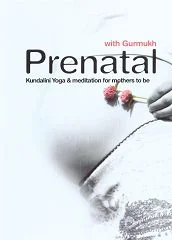
This Prenatal Yoga DVD is a 1-hour set with Gurmukh, a founder of Prenatal Yoga Khalsa Way®. Yoga is not only a physical activity, or a sequence of asanas (postures); Yoga is a union of body, mind and spirit. Allowing this union to happen in us can have an amazing impact on pregnancy, childbirth and life with a child and simply in this world.
KEGELS
Many women are wondering, should I Kegel? This article discusses the function of the pelvic floor, how to properly incorporate Kegels into your lifestyle and alternatives, if Kegels are inappropriate for you.
This document describes the function and purpose of the pelvic floor and detailed instructions on how to do kegels.
This site has pictures and description regarding the Kegel muscle.
And this article brings an opposite view on the effectiveness of Kegel exercise and talks about "New Kegels".
RESEARCH
ACOG recommends exercise for the pregnant woman and notes the benefits. You can read that PDF here.
This abstract discusses improved outcome for non-supine birth positions.