-- Section still in works --
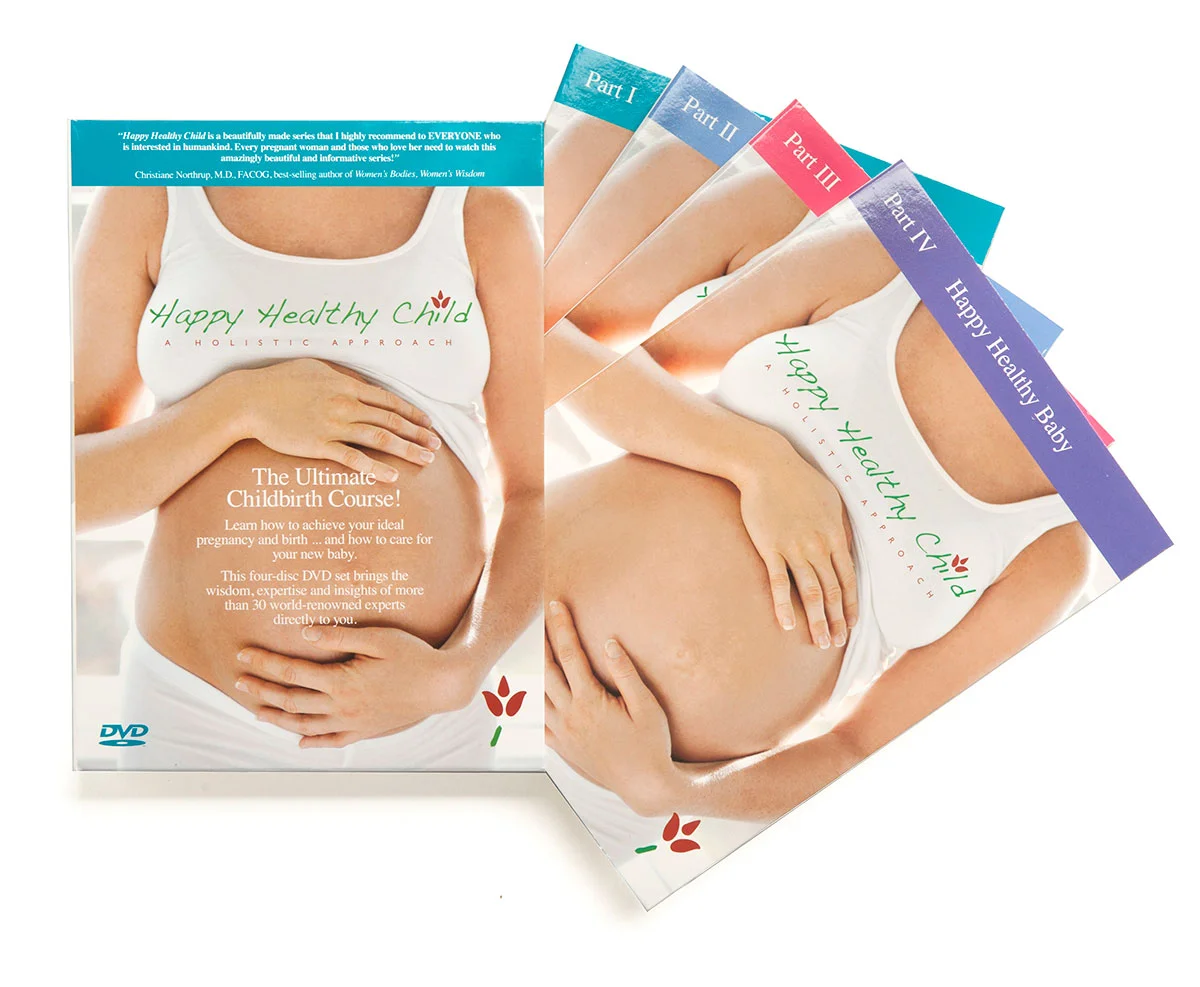
These are my very treasured and truly favorite DVD series educating about pregnancy, birth and early parenting experience. These series share the expertise, the wisdom and the insights of more than 30 of the top, world renowned experts in these areas. You can learn all of the practical information and all of the current scientific research you need in order to make the choices that are in the best interest of you and your growing family. It will help you to eliminate underlying fears and anxieties, avoid unnecessary and unwanted interventions and feel confident and ready for this wonderful time in your life.
The experts include the top OB/GYNs, midwives, pediatricians, scientists, childbirth educators, doulas, anthropologists, sleep experts, and lactation specialists.
I will lend you a copy as a part of your package, but if you'd like to keep this great resource for yourself, and wish to order it, use this promo code to get 15% off at checkout: HHC1.
I divided the 'Pregnancy' section into trimesters, but feel free to scroll up and down and to use whatever attracts your attention.
The way I organized it... The 1st trimester is mostly about choosing your care provider and place of birth and therefore making some research in those areas. It is also about setting a good, healthy tone for your pregnancy by looking into your diet and physical activity routines. Those will carry on throughout all the trimesters to come. The 2nd trimester is good time to deepen your own education about healthy pregnancy and labor a bit more. In this period, the 1st ultrasound and glucola test are typically done. In the 3rd trimester, the baby keeps growing and moving in the belly around 30 times per hour when active, and birth becomes more real and imminent. It's good time for childbirth classes if not taken before and for starting to envisioning the birth you wish to have.
1st trimester
Choosing your place of birth and your care provider - this is probably the most important decision you will make that will impact your labor and birth. It's not easy at all to make this decision early on when you just learned that you're pregnant. Early in pregnancy, we often do not have enough education, wisdom, intuitive feeling and confidence to choose what will suit what you later on define as your wishes. The intuitive feeling is though there. Deeply within you know what's best for you and what's best for your baby.
This article provides some indications towards Mother-Baby friendly practices and places.
Here described are the three models of birth and health care.
Here is a Cochrane review of Midwife-led continuity models versus other models of care for childbearing women.
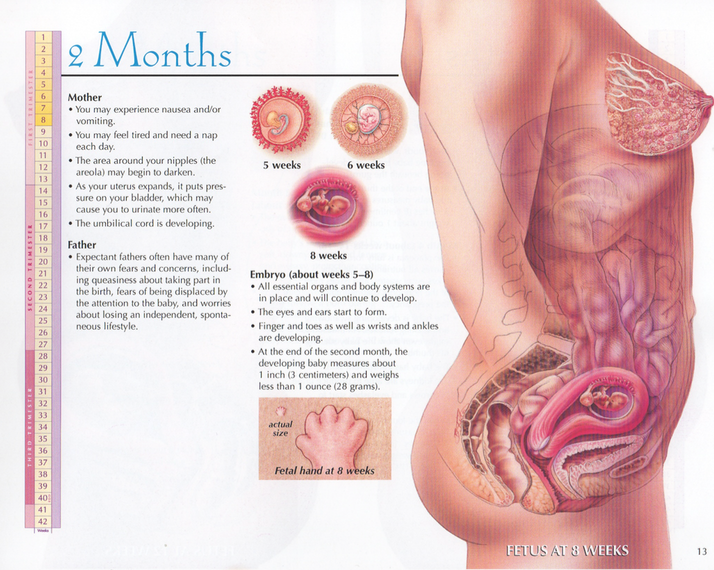
Physical and emotional progress of pregnancy from the conception till 18 weeks.
Click on the image to access the booklet.
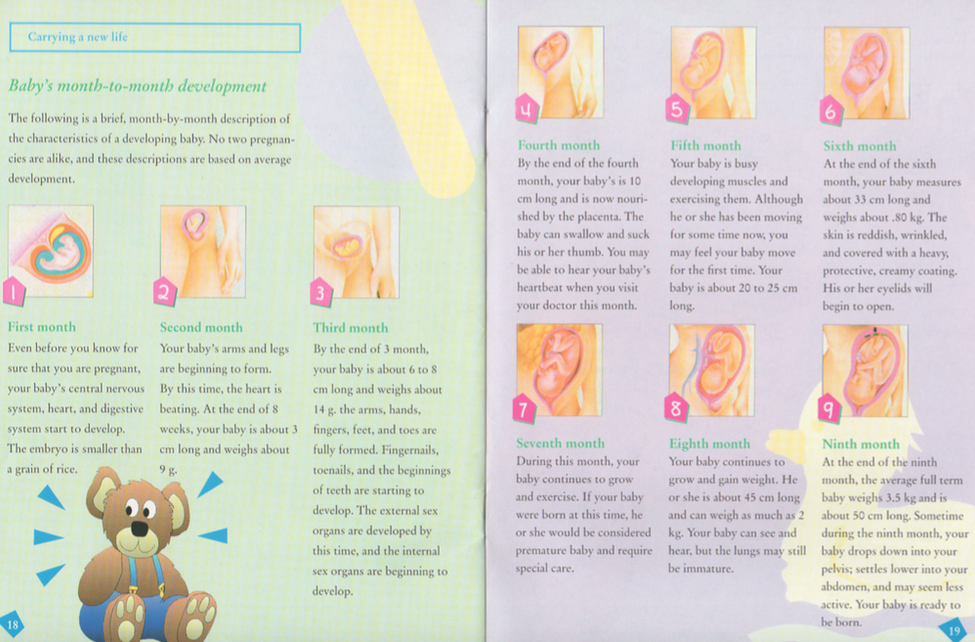
Click on the image to see a brief, month-by-month description of the characteristics of a developing baby.
If your blood Rh factor is (-), you may want to learn more what impact in may possibly have.
Check the 'Nutrition' and 'Physical Activity' sections for healthy pregnancy and best preparation for labor, birth and postpartum.
A few movies to watch:
The Business of Being Born - www.thebusinessofbeingborn.com
Orgasmic Birth - www.orgasmicbirth.com
2nd trimester
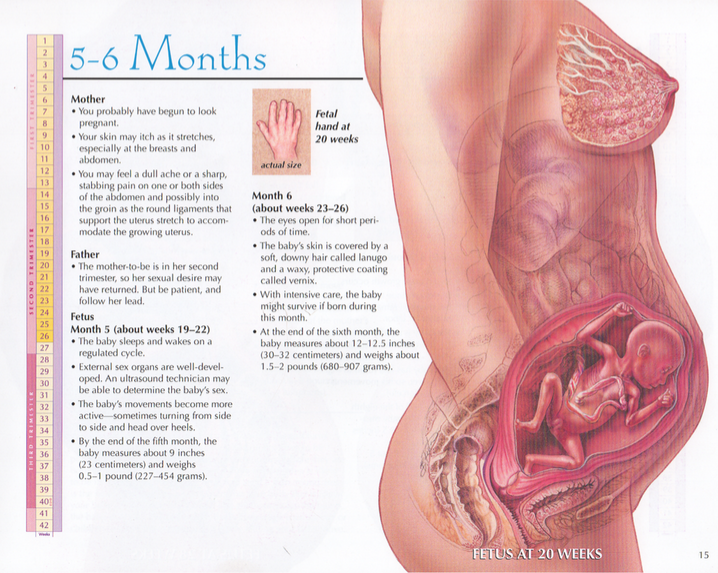
Physical and emotional progress of pregnancy at 5th and 6th month. Month 4 is included in the earlier booklet.
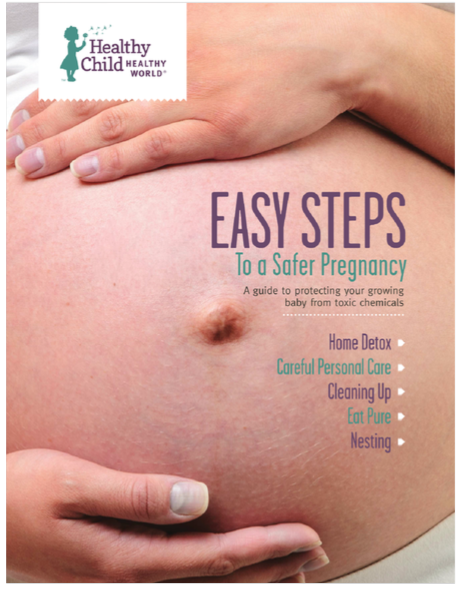
Here is great guide to a safer pregnancy.
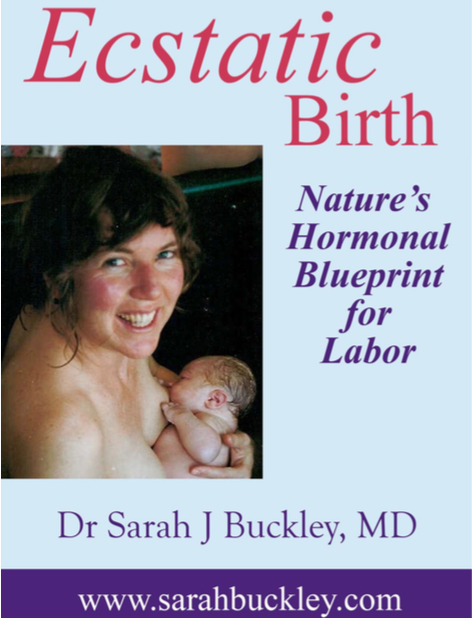
What to learn more about hormones of labor and birth? The way the nature designed it is quite amazing.
If you prefer to get a brief, extremely well-explained version of how hormones are orchestrating labor and birth, you may watch Chapter 6 on the 1st DVD of Happy Healthy Child.
Ultrasounds are for some parents one the most exciting moments of their prenatal tests. They give them a pick into their little one's life in the womb. More and more studies show though that ultrasounds are not without no impact at all. As with anything, it is your own education and ultimate decision on what you choose to do: get an ultrasound at each visit, get only the most important test at 20 weeks or get no ultrasounds at all.
Here is a fairly comprehensive list of references on the topic of ultrasound compiled by Carla Hartley so you may research the topic further.
Gestational Diabetes and the Glucola Test from Evidence Based Birth website.
Books I recommend:
- Ina May's Guide to Childbirth by Ina May Gaskin
Bountiful, Beautiful, Blissful by Gurmukh Kaur Khalsa
Start to look for a comprehensive childbirth course. A few recommendations:
- Bradley course with Mary Esther Malloy (14th street OR Inwood)
- Bradley course (8-week or intensive) with Manhattan Birth (UWS)
- Courses offered by CEA/MNY certified teachers
The 2nd trimester is still a good and more realistic time to change your care provider or place of birth if for any reasons you will come to a conclusion that this may be a better option for you and your family.
3rd trimester
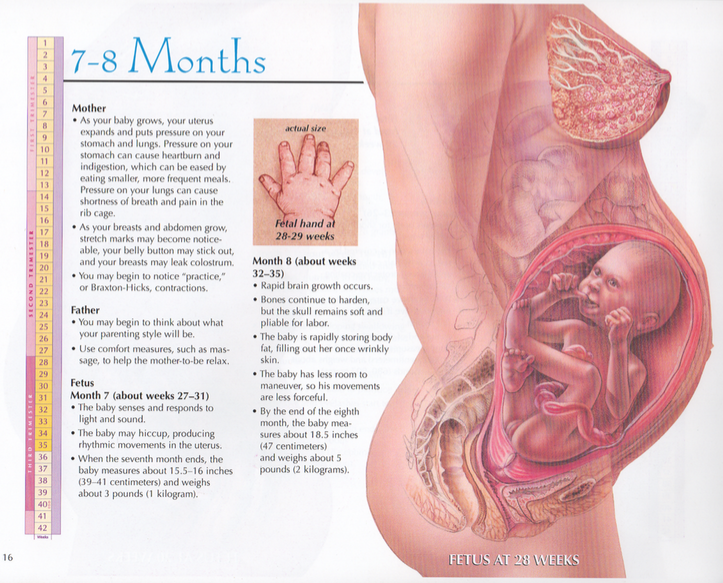
Physical and emotional progress of pregnancy from 7th to 9th month of pregnancy.
Check this website for evidence-based information on many topics related to labor and birth: due dates, pushing positions, reasons for inductions, fetal monitoring, labor augmentation, IVs during labor, antibiotics for GBS, reasons for c-section, water birth, and more.
Vaginal examinations - things to know.
Evidence behind - Eating and Drinking in labor - Cochrane review.
Why women should not give birth lying flat on their backs. Illustration and awesome labor aid for upright birth (no advertisement for the tool itself).
What hides behind a "due date"? And why don't we actually call it a "guess date"? Here is an article about the science behind days of pregnancy.
If your approaching your guesstimated date, and for any reasons it brings different emotions and thoughts to you, maybe your care provider starts to talk about induction, maybe you're fearing the birth of the baby that may grow a few ounces more... here is a very short and funny movie by Krissy and Brendan Shields that show naturals methods of bringing up labor but also a toll it may take on a couple's life.
Breech
If you your baby is in breech position when entering into 3rd trimester. There is still a lot of time for baby to turn. Most babies turn head-down between 28-32 weeks. Above all, relax. Check some things you can do at these websites:
- My Breech Baby
- Spinning Babies
- e-mail me :-)
Perineal massage is disputable. There is not research that proves that it works. The claimed benefits includes: helps prepare mother to release tension in her perineum during birth and to reduce the need for an episiotomy. Decide for yourself whether it's something you believe could help you or not.
In preparation of postpartum period
Placenta encapsulation:
- APPA: Association of Placenta Preparation Arts
Placentophagy Papers, Reviews & Studies: What They Really Mean
And my last 2 cents: :-)
It's all in a woman's power... and will.

Research about home birth
Here is the most recent and comprehensive research and statistics about the outcomes of care for nearly 17,000 planned home births.
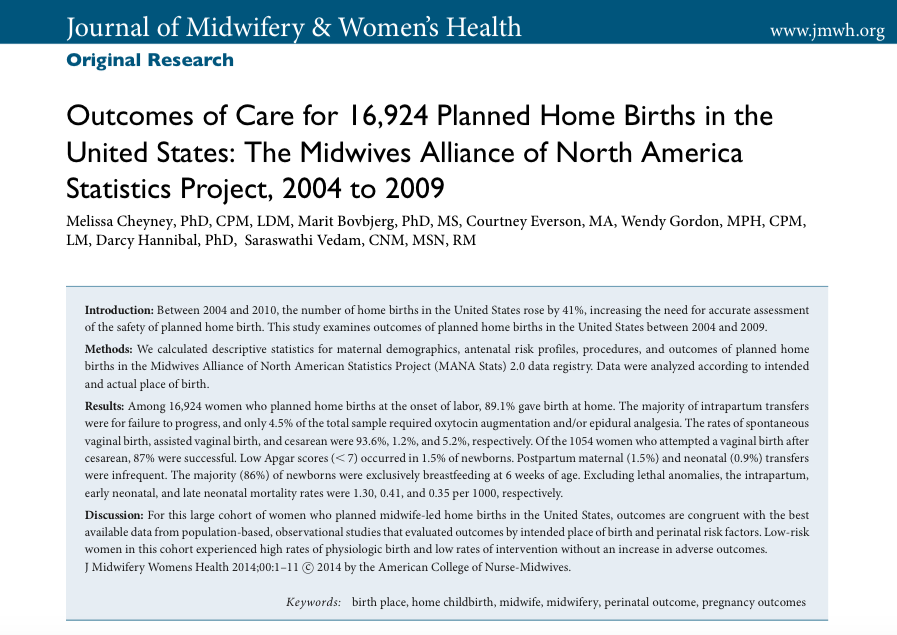
The research by MANA - Midwives Alliance of North America
Very brief summary: Out of the sample of 16,924 women who planned a home birth, 89.1% gave birth at home. 93.6% out of all transfers gave a vaginal unassisted birth in the hospital. From the total sample, only 0.57% had a c-section vs. over 30% average in the U.S.
Further below is not a research per say, but interesting videos or readings regarding home birth.
Why is midwifery care and home birth safe?
Movie: 'Why not home?' and their website.
Interesting articles
- "Why are Medical Professionals who Deliver Babies in Hospitals Choosing to have their Own Babies at Home?"
- "The Home Birth Advantage: The Physical and Emotional Benefits of Birthing at Home"
- "Why home birth is necessary?"
- "Low-risk pregnant women urged to avoid hospital births" - this is in UK
Some general and practical information on Midwifery Today website.
This movie shows so beautifully the atmosphere of a home birth. Though everybody has its own very special experience, it just gives a little peak into this peaceful, undisturbed process.
If you're interested in exploring this further, I'm happy to talk.